
What you should know
- Day trading is not a faster version of long-term investing — it follows a different decision process.
- The shorter your time horizon, the more the exact entry and exit point can shape your result.
- Long-term investing does not mean losses are impossible. It simply gives more time to move through different market phases.
- Before investing, be clear about when you are likely to need the money again and how much risk you can carry until then.
Investing and trading are not the same
Investing is the broad term for allocating capital to assets such as stocks, ETFs or bonds. The investment horizon can vary. Trading typically refers to more frequent buying and selling aimed at taking advantage of shorter-term price movements.
So the key question is not only which security you buy. Just as important are the time horizon, objective and process you bring to the market.
The main approaches compared
Day trading
Positions are typically opened and closed within the same trading day. Decisions react strongly to short-term price movements; trading costs, spreads, execution and disciplined risk management matter greatly.
Short-term investing
The holding period is longer than a single trading day, but the capital is expected to be needed again relatively soon. The shorter the horizon, the less time there is to ride out larger market losses.
Long-term investing
The plan runs over several years. The focus is more on portfolio construction, diversification, costs, risk capacity and the development of the underlying assets.
Regular investing
Capital is invested at recurring intervals, for example monthly. This is a contribution pattern rather than a separate asset class and can be combined with different long-term strategies.
Why time horizon changes risk
If you need the money again at a fixed date in the near future, a market decline shortly before that date can be especially problematic. A longer horizon does not remove market risk, but it reduces the pressure to sell during an unfavorable market phase.
Conversely, a short horizon does not automatically make a strategy more controlled or safer. More frequent decisions can create additional trading costs, execution risks and behavioral mistakes.
Where Vollat fits
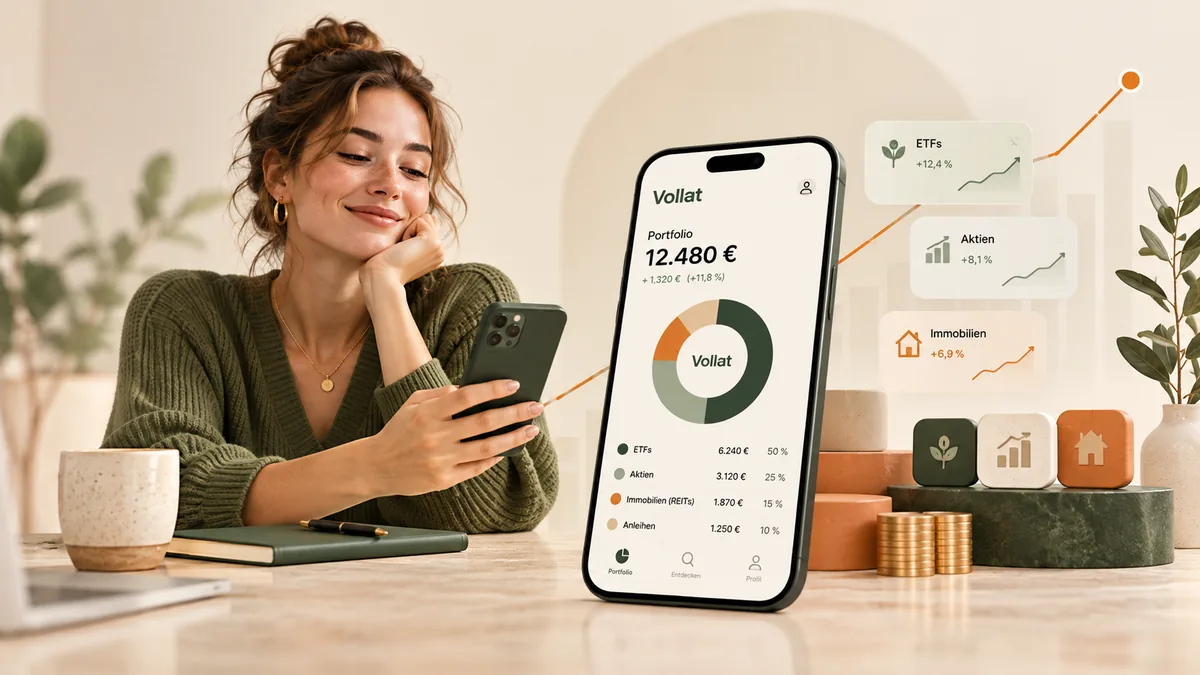
Vollat is designed to help you understand, build and develop portfolios. The app shows allocations, risks, weights and possible adjustments. It is not a day-trading terminal and does not try to provide short-term buy or sell signals for individual minutes or hours.
Even with long-term investing, Vollat does not decide for you. The app is a learning and portfolio tool; execution, broker choice and the decision whether a strategy fits your personal situation remain yours.
Short answers to common beginner questions
Is day trading investing?
In a broad sense capital is being used, but in practice day trading and classic investing differ substantially. Day trading uses very short holding periods and more frequent decisions; investing is typically more focused on wealth building and a longer time horizon.
What counts as short-term investing?
There is no universal cutoff. What matters is that the capital is expected to be needed again within a relatively short period. The closer that point is, the more important liquidity and the risk of an unfavorable exit become.
When is an investment long term?
There is no hard cutoff here either. It usually means a multi-year horizon in which short-term market moves do not determine every decision. The appropriate duration depends on the specific goal and product.
Is long-term investing automatically safer?
No. Stocks, ETFs and other securities can cause losses even over long periods. A longer horizon changes the risk structure but does not remove risk.
Independent fundamentals
For financial topics, do not rely on claims from a product page alone. These neutral or public sources are useful for the fundamentals.